
If you own a car in Korea, car insurance is not the only regular cost you need to think about.
Another expense is automobile tax, or 자동차세 in Korean.
Automobile tax is a local tax charged to the registered owner of a vehicle. It is separate from your car insurance premium, registration costs, fuel, maintenance, and other vehicle expenses.
For many foreigners, one part of the Korean system can be surprising:
For most privately owned passenger cars, automobile tax is not based on how much the car is worth.
A luxury car does not automatically have a higher annual car tax simply because it was expensive to buy. For most gasoline and diesel passenger cars, the main factor is the size of the engine.
That means a relatively inexpensive car with a large engine can sometimes have a higher automobile tax than a much more expensive car with a smaller engine.
How Is Automobile Tax Calculated in Korea?
For most non-commercial passenger cars, the basic automobile tax is calculated according to engine displacement, which is measured in cubic centimeters, or cc.
The standard rates are:
- 1,000cc or less: KRW 80 per cc
- 1,001cc to 1,600cc: KRW 140 per cc
- Over 1,600cc: KRW 200 per cc
A local education tax is generally added at 30% of the automobile tax amount.
So when people talk about the amount they actually pay each year, the total is usually higher than the basic cc calculation alone.
Here are some simple examples for a privately owned passenger car before any vehicle-age reduction:
- 1,000cc: about KRW 104,000 per year including local education tax
- 1,600cc: about KRW 291,200 per year
- 2,000cc: about KRW 520,000 per year
- 2,500cc: about KRW 650,000 per year
- 3,000cc: about KRW 780,000 per year
These figures are useful as a general guide, but the actual bill can be different depending on the vehicle's age, ownership period, tax reductions, and other circumstances.
A More Expensive Car Does Not Always Mean Higher Tax
This is probably the biggest difference many foreign drivers notice.
Imagine two cars:
- Car A costs KRW 25 million and has a 3,000cc engine.
- Car B costs KRW 70 million and has a 1,600cc engine.
Even though Car B is much more expensive, Car A may have a substantially higher annual automobile tax because its engine displacement is larger.
So when comparing cars in Korea, it is worth checking more than just the purchase price.
A larger engine may affect:
- automobile tax
- fuel costs
- insurance premiums in some cases
- overall running costs
This becomes especially important when buying a used car. A large-engine used vehicle may look cheap to purchase, but the annual ownership costs can still be relatively high.
Older Cars Can Receive an Automobile Tax Reduction
Another important part of the Korean automobile tax system is the vehicle-age reduction.
For most non-commercial passenger cars that are subject to the engine-displacement tax, the tax begins to decrease from the third year.
The reduction increases by 5 percentage points each year until it reaches a maximum reduction of 50%.
The standard reduction schedule is:
- 3rd year: 5% reduction
- 4th year: 10%
- 5th year: 15%
- 6th year: 20%
- 7th year: 25%
- 8th year: 30%
- 9th year: 35%
- 10th year: 40%
- 11th year: 45%
- 12th year and older: 50%
This means two cars with exactly the same engine size can have different annual automobile tax bills simply because one is older.
For example, a 2,000cc passenger car has a basic automobile tax of KRW 400,000 before local education tax.
If the car is in its fifth year, the automobile tax receives a 15% age reduction.
That brings the basic tax down to approximately KRW 340,000.
After adding the standard 30% local education tax, the total would be approximately KRW 442,000, rather than KRW 520,000 for a newer 2,000cc car.
For people shopping for an older used vehicle in Korea, this can make a noticeable difference over time.
When Do You Pay Automobile Tax in Korea?
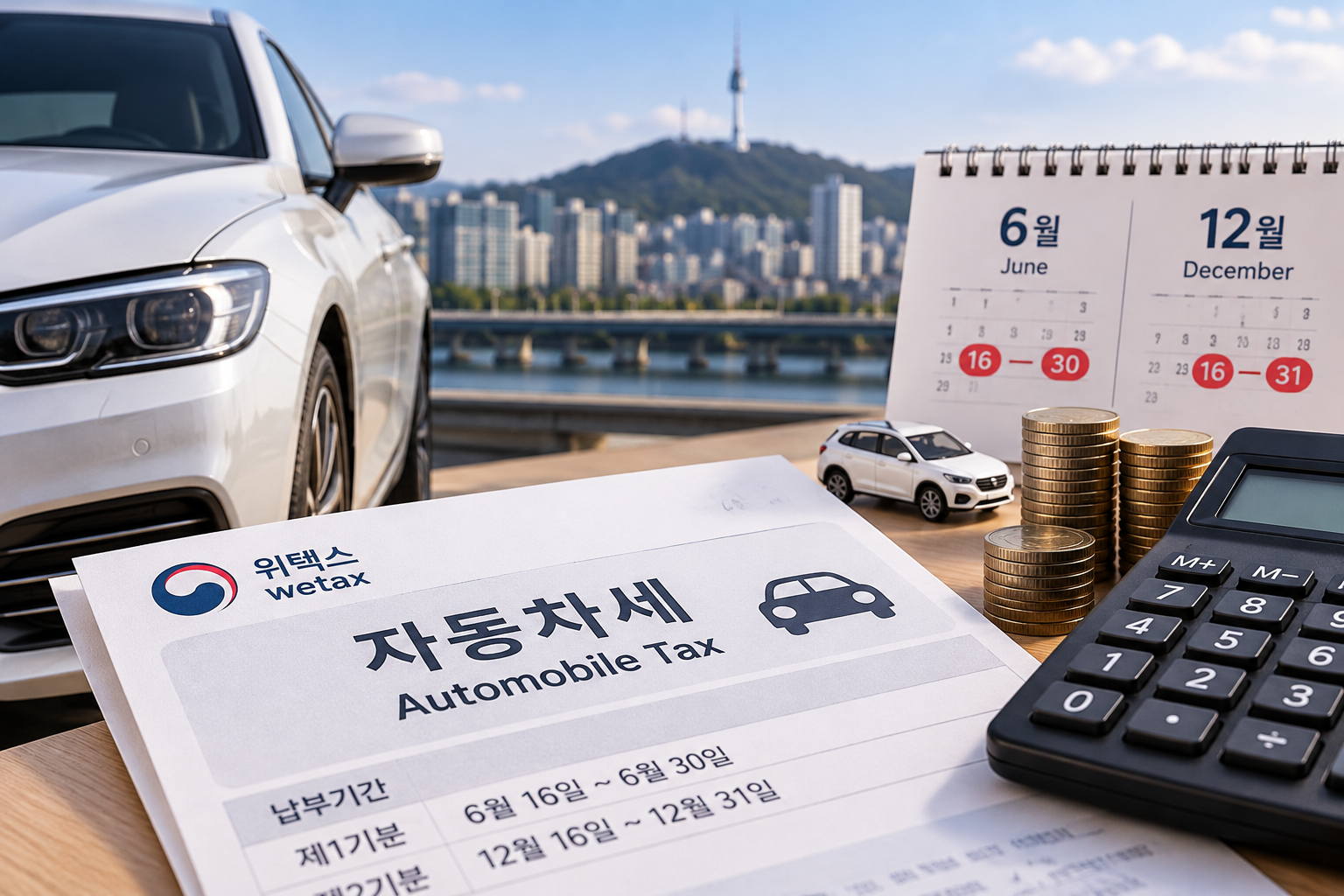
Automobile tax is generally divided into two billing periods each year.
The normal payment periods are:
- First half: June 16 to June 30
- Second half: December 16 to December 31
So most vehicle owners receive an automobile tax bill twice a year.
There are some exceptions. Vehicles with a relatively small annual tax amount may have the full amount collected during the first billing period. Vehicle owners can also have different billing situations when a car is newly registered, sold, transferred, or deregistered.
If you sell or transfer your car during the year, automobile tax can generally be calculated according to the period during which you owned the vehicle.
Can You Pay Automobile Tax Early?
Korea also has a system that allows vehicle owners to pay annual automobile tax in advance.
Depending on the applicable rules for that year and when you make the payment, an early-payment reduction may be available.
This is commonly called 자동차세 연납 in Korean.
If you plan to keep your car for the whole year, it can be worth checking your local government tax notice or the Wetax system to see whether advance payment is available and what reduction currently applies.
Because the advance-payment formula can change, it is better to check the current year's rate rather than rely on an old percentage you may find online.
What About Electric Cars?
Electric vehicles are an important exception because they do not have a traditional engine displacement measured in cc.
For non-commercial passenger vehicles that are not taxed by engine displacement, the standard annual automobile tax is generally KRW 100,000.
With the standard 30% local education tax added, the total is commonly about KRW 130,000 per year.
This is one reason the automobile tax on an electric vehicle can be significantly lower than the tax on a large-engine gasoline vehicle.
However, purchase taxes, government incentives, insurance premiums, and other ownership costs follow different rules, so automobile tax should only be considered one part of the total cost.
Automobile Tax, Insurance, and Registration Costs Are Different
This is another area that can confuse people who are new to Korea.
When you buy a car, you may need to deal with several different costs.
Automobile tax is a recurring local tax for owning the vehicle.
Car insurance provides insurance coverage for liability, accidents, vehicle damage, and other risks depending on the policy.
Acquisition and registration-related costs are taxes and fees associated with purchasing and registering a vehicle.
These are separate expenses.
Paying your car insurance does not mean your automobile tax has been paid, and paying automobile tax does not provide any insurance coverage.
Why This Matters When Buying a Used Car in Korea
A low purchase price does not always mean a car will be inexpensive to own.
Suppose you find an older imported sedan at a very attractive price. The car may look like a bargain, but if it has a 3,000cc or 3,500cc engine, you should still consider the annual automobile tax, fuel economy, insurance cost, repair costs, and replacement parts.
On the other hand, the age-based automobile tax reduction may make an older vehicle less expensive to tax than a newer vehicle with the same engine size.
That is why it is better to look at the total cost of ownership rather than only the sale price.
Before buying a car in Korea, consider:
- purchase price
- acquisition and registration costs
- annual automobile tax
- car insurance
- fuel
- parking
- maintenance and repairs
For foreigners who are buying their first car in Korea, these separate costs can be easy to overlook.
A Simple Way to Estimate Your Car Tax
For a typical non-commercial gasoline or diesel passenger car, you can make a quick estimate like this:
- Check the engine size in cc.
- Apply the appropriate cc rate.
- Apply any vehicle-age reduction if eligible.
- Add the local education tax.
For example, a newer 2,000cc car:
2,000 × KRW 200 = KRW 400,000 automobile tax
Then add approximately 30% local education tax:
KRW 400,000 + KRW 120,000 = approximately KRW 520,000 per year
That gives you a useful estimate before you purchase the vehicle.
Final Thoughts
Understanding automobile tax in Korea is useful before buying, registering, or budgeting for a car.
The most important thing to remember is that, for most private gasoline and diesel passenger cars, the tax is mainly based on engine size rather than the market value of the vehicle.
A larger engine generally means a higher automobile tax, while an older eligible vehicle may receive a significant age-based reduction.
And remember: automobile tax, car insurance, and registration-related expenses are separate costs.
If you are planning to buy a car in Korea, especially as a foreign resident, take a few minutes to calculate the total annual cost before making your decision. A car that looks inexpensive at first can sometimes cost more to own than expected.
Official References
Need Car Insurance in Korea?
Get Help in English
Tell us about your vehicle and situation. We can compare available options and help you understand the coverage before you decide.