
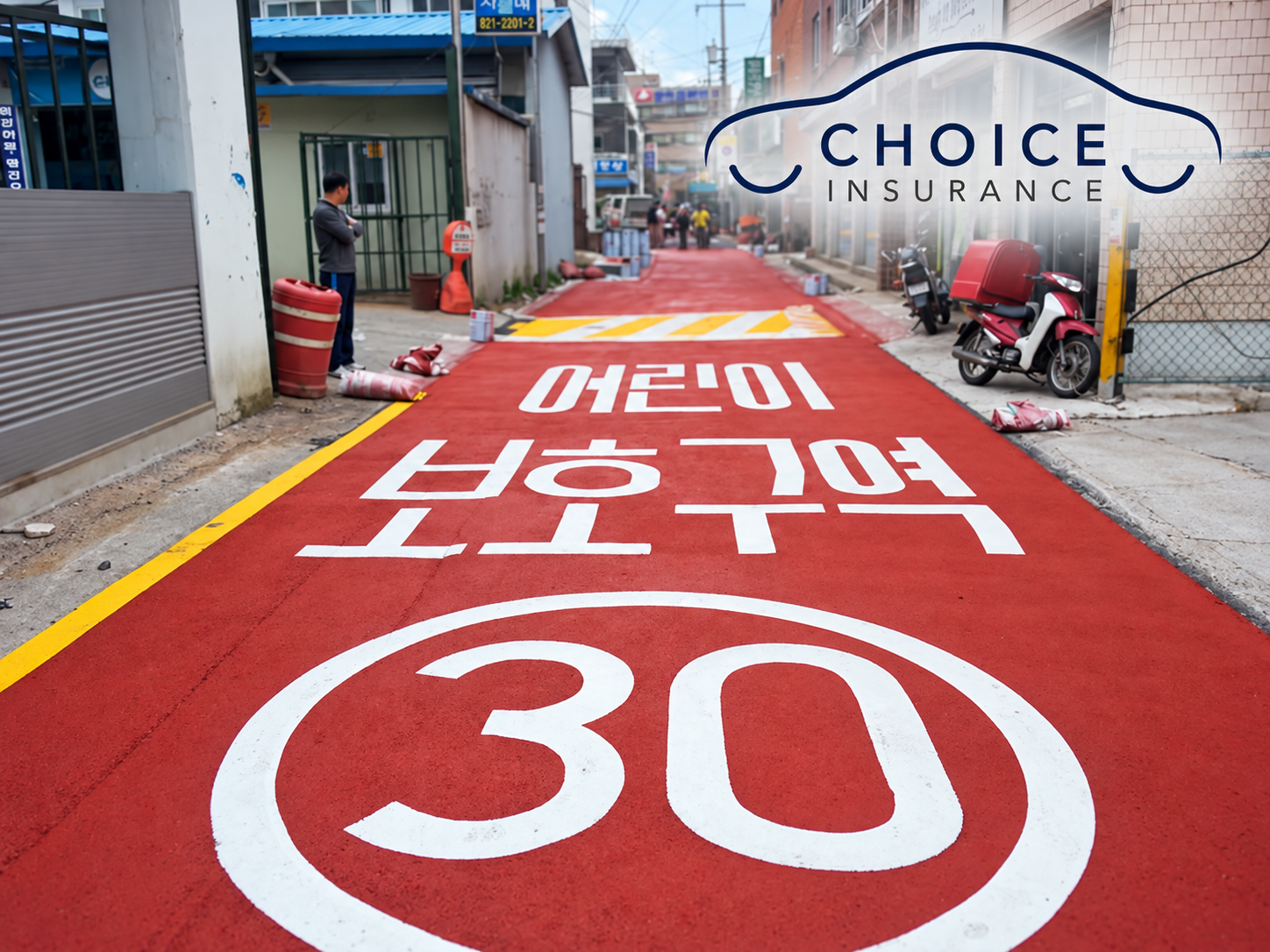
If you drive in Korea, one road marking deserves your full attention: 어린이 보호구역, or a child protection zone.
You will usually find these zones around elementary schools, kindergartens, daycare centers, and other places where young children regularly cross the road. In most cases, the designated area covers roads within about 300 meters of the main entrance, although it can extend to 500 meters when local traffic conditions make that necessary.
The most important rule is simple: slow down. In a child protection zone, the speed limit can be restricted to 30 km/h or lower.
For foreign drivers, the rules can feel stricter than expected. That is intentional. Children can step into the road suddenly, appear from behind a parked vehicle, or cross before a driver expects them to. Korean traffic law therefore expects drivers to use extra caution in these areas.
How can you recognize a child protection zone?
The easiest clue is the road itself.
Many child protection zones in Korea use red or reddish road pavement, large white Korean lettering, speed-limit markings, warning signs, speed cameras, and other highly visible features.
If you see a red road like the one in the photo, especially near a school or kindergarten, it is a good idea to immediately slow down and look for school-zone signs.
That said, red pavement is a helpful visual clue, not the legal definition of a school zone. Road designs can vary by city and location. Always follow the posted signs and road markings.
Why are the rules so strict?
A major turning point came after a tragic accident in 2019.
On September 11, 2019, a 9-year-old boy named Kim Min-sik was struck and killed in a child protection zone in Asan, South Chungcheong Province.
The accident received nationwide attention and raised a difficult question: if an area is officially designated to protect children, are the road design, enforcement, and penalties strong enough to actually do that?
The public discussion that followed led to legal changes that became widely known as Min-sik Law.
The legislation passed the National Assembly in December 2019 and took effect on March 25, 2020.
What changed under Min-sik Law?
Min-sik Law is usually used as a general name for two major changes.
The first focused on school-zone safety equipment. Changes to the Road Traffic Act strengthened the installation of safety facilities such as speed-enforcement cameras and traffic signals in child protection zones.
The second change was more serious for drivers. The Act on the Aggravated Punishment of Specific Crimes introduced stronger penalties when a driver violates the required duty of care in a child protection zone and causes injury or death to a child under 13.
Under the current law, when the legal requirements for the aggravated offense are met:
- causing the death of a child can result in life imprisonment or imprisonment for at least three years
- causing injury can result in one to fifteen years of imprisonment or a fine of 5 million to 30 million won
Those numbers sound severe because the law is designed for serious cases involving a failure to follow the special safety duties that apply in a child protection zone.
Does every accident in a school zone mean severe punishment?
No.
This is one of the most common misunderstandings about Min-sik Law.
The fact that an accident happened inside a child protection zone does not automatically mean the driver receives the maximum punishment. Investigators still look at the circumstances, including whether the driver followed the speed limit, watched for children, obeyed signals and crosswalk rules, and fulfilled the required duty of care.
But from a practical driving point of view, there is no good reason to take chances.
When you enter a school zone, assume that a child could appear unexpectedly and drive slowly enough to stop immediately.
What should foreign drivers do?
A few habits make these areas much easier to handle:
- reduce your speed before entering the zone
- keep your eyes on sidewalks, parked cars, and crosswalks
- leave more stopping distance than usual
- do not rush through a crossing just because it looks empty
- pay close attention to parking and stopping restrictions
- watch for cameras and posted speed-limit signs
- when you are unsure, choose the slower and safer option
You may also notice that penalties for traffic violations in child protection zones are higher than on ordinary roads. The exact amount depends on the violation, so it is better not to rely on a single rule such as "the fine is always three times higher."
An easy rule to remember
If you are new to Korea, use this simple rule of thumb:
Red road near a school? Slow down first and figure out the details second.
It may not be a perfect legal test, but it is a very good driving habit.
School zones are designed to give children an extra margin of safety. A few seconds of slower driving can make a much bigger difference than most drivers realize.
Official references
For the current legal rules, see the Korean National Law Information Center and official government guidance:
Need Car Insurance in Korea?
Get Help in English
Tell us about your vehicle and situation. We can compare available options and help you understand the coverage before you decide.